
| Jan 8, 2026
Why Fiber Laser Marking Has Become the Manufacturing Standard
Industrial marking requirements are not the same as they were even 10 years ago. Today, manufacturers need marking systems that are ultra fast, consistent, and produce marks permanent enough to support traceability throughout a product’s lifecycle.
Production speeds have increased and compliance requirements are now more rigid. Older marking methods simply aren’t living up to today’s expectations. That’s why fiber laser marking has become the manufacturing standard across industries, ranging from medical devices to automotive and aerospace.
To meet manufacturer requirements today, marking systems must provide:
- Fast, reliable marking
- Consistent readability
- Permanent marks that withstand harsh environments
- Support for traceability and compliance requirements
- Low maintenance in 24/7 operations
Faster, High-quality Marking
One of the biggest reasons manufacturers choose fiber laser marking is speed. Fiber lasers can mark metals significantly faster than legacy marking technologies, which helps reduce cycle times and support higher throughput. In many applications, manufacturers see marking speeds that are two to three times faster than previous solid-state systems.
What’s more, fiber laser marking achieves these speeds without compromising quality. There are no inks, additives, or consumables involved, which means fewer production interruptions and more predictable uptime. This is especially advantageous for high-volume or multi-shift environments, where efficiency is crucial.
Consistent, Permanent Marks for Every Part
Speed alone isn’t enough if marking quality varies from part to part. Fiber laser systems deliver exceptional consistency thanks to stable beam quality and precise pulse control. They provide uniform mark depth and contrast, even across thousands or millions of parts.
Fiber laser marks are also permanent. They can withstand heat, abrasion, chemicals, and cleaning processes, so readability is maintained throughout the life of the product. Fiber laser markers are also used for deep engraving for applications like automotive VIN marking. This is essential for reliable downstream scanning and long-term traceability.
Flexibility Across Materials and Applications
Fiber laser marking has expanded the applications and materials that manufacturers can mark. These systems perform exceptionally well across many common production materials, including:
- Steel, aluminum, titanium, copper, and brass
- Anodized and coated metal surfaces
- Many engineered plastics
Advanced pulse control, including VP MOPA (Variable Pulse) fiber laser technology, gives manufacturers even greater flexibility. By adjusting pulse duration, users can fine-tune marking results for different materials to achieve high-contrast plastic marks, cleaner annealing on stainless steel, or deeper engraving without excessive heat.
Lower Maintenance and Long System Life
Compared to older marking technologies, fiber laser systems are virtually maintenance-free. There are no lamps to replace, no gas refills, and no mirror alignment required.
Typical fiber laser maintenance includes:
- Basic lens cleaning
- Occasional filter changes
- No lamps, gas refills, or mirror alignment
With diode lifespans exceeding 100,000 hours, fiber laser systems are well-suited for 24/7 production environments. This delivers lower total cost of ownership, less downtime, and long-term reliability.
Built for Traceability and Compliance
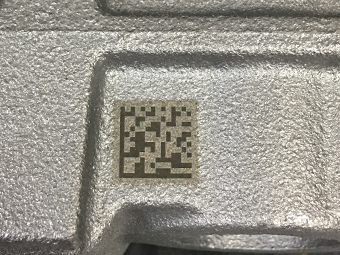
With more focus on traceability today, fiber laser marking provides the permanence and precision required for regulated industries. These systems produce tamper-resistant 2D codes such as DataMatrix and QR codes that support standards including FDA UDI, automotive IATF 16949, and aerospace requirements.
When paired with vision systems and automation, fiber laser marking ensures consistent quality even at high line speeds. Advanced systems integrate with ERP and MES platforms to digitize traceability, logging every mark from raw material through finished product.
Learn more about fiber laser customization and automation options.
The New Baseline for Industrial Marking
Fiber laser marking has become the baseline expectation for modern manufacturing. Its combination of speed, consistency, material flexibility, low maintenance, and traceability support makes it the clear choice for today’s production environments.
Choosing the right fiber laser system – along with the right integration partner – ensures manufacturers fully realize these benefits as marking requirements continue to evolve.
MECCO offers a complete portfolio of fiber laser marking systems, from standalone solutions to fully integrated, automated platforms. Each system is engineered to deliver consistent, permanent marks that support modern manufacturing and traceability requirements.
Talk with MECCO’s marking experts to determine which fiber laser system is best suited for your application, materials, and production environment.