
| Mar 11, 2026
Why Dot Peen Marking Remains a Trusted Choice for Oil and Gas Equipment
Oil and gas components endure a long, tough life. Whether it’s a wellhead sitting on the ocean floor or a coupling dragged through dirt, these parts are expected to last decades in some of the harshest environments on earth. Extreme heat, Arctic cold, saltwater submersion, sand abrasion, acid baths, and power washing are the standard.
Part identification has to hold up in these rough conditions. Savvy manufacturers who build oil and gas components like valves, flanges, pipes, and downhole assemblies rely on dot peen marking for part identification. Here’s why.
Dot Peen Marks Runs Deep
While some marking methods sit on top of a surface, dot peen marks go much deeper.
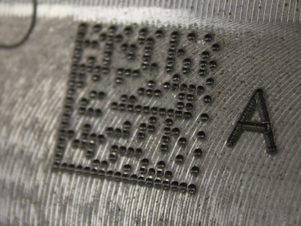
Instead of removing or burning material, dot peen physically displaces it to create impressions up to 0.5mm deep in high-strength metals like carbon steel, stainless steel, and superalloys like Inconel. That depth is what allows a mark to survive painting, galvanization, sandblasting, power washing, and years of surface rust or scale buildup.
Additionally, because it doesn’t utilize heat or chemical action, it doesn’t alter the chemical composition of the steel or compromise fatigue life. This is crucial for structural and pressure-bearing components in oil and gas.
Even after coating or under heavy crude oil, the mark is still there because of the deep, permanent indent, not just a topical application.
How Dot Peen Compares to Other Marking Methods
A quick comparison of dot peen to other marking methods reveals why it’s the primary choice for oil and gas manufacturers:
- Inkjet and paint marking degrade quickly in the field. UV exposure, saltwater, and abrasion break down ink-based marks within months or years.
- Chemical etching produces marks that are too shallow to withstand oxidation, sand scouring, or the kind of post-service cleaning common in oil and gas operations.
- Laser engraving offers excellent resolution and durability, and is a strong choice for high-precision marking in many cases. However, achieving the same depth as dot peen can require requires multiple laser passes.
- Hand stamping produces deep marks, but inconsistently. It depends on the operator hitting the stamp with the right force in the right location every time. Dot peen automates that precision and is easier on the worker.
Summary Comparison
| Marking Method | Depth | Survives Painting? | Survives Abrasion? | Life Expectancy |
| Dot Peen | Deep (up to 0.5mm) | Yes (High) | Excellent | Decades |
| Laser Engraving | Variable | Yes (Moderate) | Excellent | Decades |
| Inkjet / Paint | Surface | No | Poor | Months/Years |
| Chemical Etch | Very Shallow | No | Poor | Years |
Portability Matters
Many oil and gas components can’t be moved to a marking station. For example, a large valve assembly, floor-mounted manifold, or heavy drill collar requires the marking system to come to the part, not the other way around.
Handheld, portable and combination dot peen units are ideal for heavy or uncommonly shaped parts found in the oil and gas industry. MECCO’s portable dot peen marking machines are rugged, shop-floor ready, and allow workers to mark heavy, immobile assets in the field with digital precision (including timestamps and serialized Data Matrix codes).
Traceability, Compliance, and Downstream Stakes
Dot peen systems can apply high-density 2D Data Matrix codes compliant with ISO 29158 for direct part marking quality. They securely store heat numbers, serial numbers, dates, and other traceability data in a compact, machine-readable format. When integrated with PLCs (Programmable Logic Controllers) or manufacturing databases, every mark made is automatically logged, creating a digital paper trail that supports regulatory audits and recall management.
Because the mark is physically indented into the metal, it’s also virtually tamper-proof. It cannot be altered or removed without leaving obvious evidence. Oil and gas customers greatly value this feature for counterfeit prevention and warranty verification.
Lower Total Cost of Ownership
On cost, dot peen’s economics make sense. They require no inks, chemicals, or replacement cartridges. The primary consumable is a carbide stylus that can be reground or replaced after thousands of marks. For high-volume operations, that translates to a meaningfully low total cost of ownership over the life of the system.
A Dot Peen Case Study in Oil and Gas
Walkup Co., a U.S. fabricator serving oil field customers with strict quality standards, was relying on hand stamping to mark part identification numbers on steel components. The process was slow, causing injuries, and the marks weren’t surviving the company’s three-coat paint system. After switching to MECCO’s COUTH N-34 dot peen marker, marking time dropped to five seconds per part and held up through the coating.
“Marking 20 characters by hand on each part took a lot of time, but with the N-34, it’s five seconds.” – Walkup Co.
Dot Peen Reigns in Oil and Gas Part Marking
Dot peen marking has remained a trusted method in oil and gas because it consistently solves actual problems the industry faces: keeping parts readily identifiable in harsh environments for their entire lifecycle.
MECCO helps oil and gas manufacturers overcome these challenges with dot peen marking solutions that offer the ideal combination of mark depth, material integrity, and portability. Whether you need a portable unit for field marking or an integrated system for high-volume production, MECCO’s application engineers can help you find the right solution for your specific parts, materials, and environment. Request a demo today.