

| Nov 24, 2025
Solving Compliance Challenges with Better Traceability in Complex Global Supply Chains
As today’s supply chains grow more complex, global regulations become tighter. To deal with these shifts, manufacturers are adopting modern traceability systems that improve visibility while reducing compliance costs by as much as 20-30%.
As supplier networks expand across continents and trade regulations are constantly evolving, maintaining compliance has become one of the most daunting challenges in manufacturing. In this article, we’ll explore the trends and learn how manufacturers are adapting.
The Rising Complexity of Global Supply Chains
Globalization has created multi-tiered supply networks that involve hundreds of suppliers and thousands of touchpoints across dozens of countries. Any trade dispute, natural disaster, or policy change can hamper the ability to track products by creating “blind spots” in visibility.
When manufacturers lose sight of part origins or movement across borders, the consequences ripple fast. This can mean delayed production, counterfeit parts, tariff miscalculations – and lost revenue. In short, gaps in visibility can turn into a serious operational and financial liability.
Tariffs and Industry Standards Require Stronger Traceability
Reciprocal tariffs are a hot topic these days, and these policies require precise country-of-origin verification. Manufacturers must now prove exactly where components come from to avoid penalties and qualify for trade exemptions like USMCA.
At the same time, industry-specific standards are tightening across nearly every sector, adding new documentation, verification, and audit demands. For example:
- Automotive: ISO 26262 and ASPICE safety standards
- Aerospace & Defense: AS9100 and export control requirements
- Electronics: REACH and e-waste regulations
- Energy & Chemicals: Ethical sourcing and sustainability mandates
Each layer raises the stakes for compliance, making traceability more essential than ever.
How Permanent Laser Marks Simplify Verification
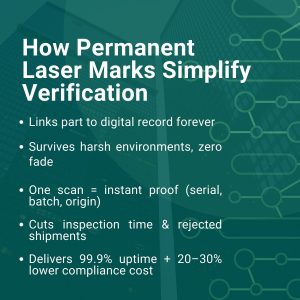
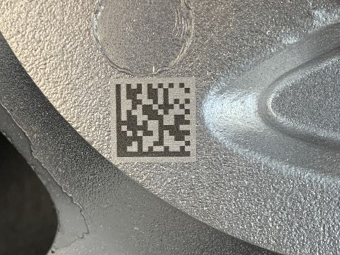
Permanent laser marks, such as DataMatrix codes etched directly onto parts, create a link between the physical product and its digital record. These high-contrast marks remain readable even in harsh environments, ensuring a verifiable chain of custody throughout the product’s lifecycle.
This durability is key for customs, audits, and certifications. A quick scan of a laser-marked code can instantly verify serial numbers, batch data, or country of origin to support everything from UDI requirements to CE/FDA certifications.
For manufacturers, that means faster inspections, fewer rejected shipments, and a clear audit trail that satisfies even the strictest regulations. In high-stakes industries like aerospace, they support AS9100 traceability, minimizing downtime from failed inspections.
MECCO systems have helped manufacturers achieve 99.9% uptime by integrating marking data with ERP for automated reporting. Overall, these capabilities reduce compliance costs by 20–30% and enable blockchain and IoT integration for tamper-proof verification.
MECCO systems have helped manufacturers achieve 99.9% uptime and cut compliance costs by up to 30%.
Connecting the Data for Seamless Compliance
As the risks of counterfeiting or product recalls increase, manufacturers are turning to high-quality, permanent laser marking systems to strengthen compliance.
MECCO’s EtherMark® technology connects these systems directly to factory automation networks through standard protocols like EtherNet/IP™, Modbus, and OPC, linking each part’s unique identifier – such as a 1D barcode or 2D DataMatrix code – to enterprise databases like ERP or MES.
For operations that don’t require full network integration, MECCO also offers custom graphical user interfaces (GUIs) that provide the same data connection and traceability. Both approaches create real-time visibility, eliminate manual entry, and maintain a continuous, verifiable record of each component from production to delivery.
These capabilities offer some key advantages:
- Automated data flow: Data like serial numbers, job names, and cycle times are transferred instantly with no manual entry required.
- Error-proof documentation: Every mark is tied to the right part and order for audit-ready accuracy.
- Flexible integration: Works across diverse sites and networks without the need for custom coding.
Whether through simple 1D barcodes or dense 2D matrix codes, each part can be tracked across borders, facilities, and suppliers with a single scan for consistent and compliant global records.
Eliminating Compliance Gaps for a Global Automotive Manufacturer
When a global automotive manufacturer faced country-of-origin verification challenges and exposure to tariff penalties, MECCO and partner iTRACE implemented an EtherMark-integrated laser marking system with DataMatrix serialization. The marks were linked to a secure blockchain database, creating end-to-end traceability for critical components.
The outcome: faster customs clearance, counterfeit prevention, and a verified chain of custody that eliminated costly compliance gaps across their global supply chain.
The Future of Compliance Is Connected
Looking ahead, technologies like AI, IoT, and blockchain will enhance traceability even further with predictive analytics, real-time monitoring, and optimized routing. Together, these will help manufacturers create “digital twins” of their operations, making it easier than ever to simulate and detect compliance issues before they occur.
MECCO can help incorporate these technologies into your traceability protocols to stay ahead of the compliance game. Our EtherMark® integration and permanent marking solutions connect every part and data point to provide the verifiable chain of custody you need for an increasingly complex supply chain.
Contact MECCO to learn how our traceability and marking technologies can help you stay compliant, cut costs, and build a more resilient supply chain.